


In my last two posts on Romans 1, I shared how I first worked through this passage years ago. I also made you a promise: an update on how I read it now.
Here it is.
I no longer believe the argument from “nature” in Romans 1 is Paul’s argument at all.
I know how that sounds. So let me be precise. Paul wrote these words. They sit on his page, in his letter. But I’ve come to believe he wrote them the way a skilled debater might lay out his opponent’s opening argument, in the opponent’s own terms, so that everyone in the room hears it clearly right before he takes it apart.
There is extensive academic support on this matter, but my goal here is to make the heart of it simple.
Let’s start with something you may not know about your Bible.
Ancient Letters Didn’t Have Quotation Marks
Paul wrote in Greek, and the oldest copies of his letters have no quotation marks. They have almost no punctuation at all. The words often run together without even a space between them.
That means every quotation mark in your English Bible was put there by a translator. Someone had to decide who was talking.
Imagine reading the transcript of a debate after someone has deleted every speaker’s name. You would have to work out, from the content and the tone, who is saying what. That is the situation we are in with Paul’s letters.
Most of the time, it’s easy. But not always. And sometimes translators change their minds.
Here is an example, and it happens to be about sex. The 1984 edition of the New International Version rendered 1 Corinthians 7:1 like this:
“Now for the matters you wrote about: It is good for a man not to marry.” (1 Corinthians 7:1, NIV 1984)
Read that way, Paul is giving his own advice. Then the 2011 update of the NIV changed it:
“Now for the matters you wrote about: ‘It is good for a man not to have sexual relations with a woman.’” (1 Corinthians 7:1, NIV 2011)
Did you see what moved?
The quotation marks.
Most modern translations now read that line as a slogan from the Corinthians’ own letter to Paul. Paul quotes it so he can push back on it in the verses that follow. The Greek never changed. Our understanding of who was speaking did.
Paul wasn’t inventing anything here. Teachers in his world trained their students in a skill called speech-in-character (the Greek term is prosopopoeia): giving voice to another person, in that person’s own words and style, in order to make a point. His audience would have recognized it.
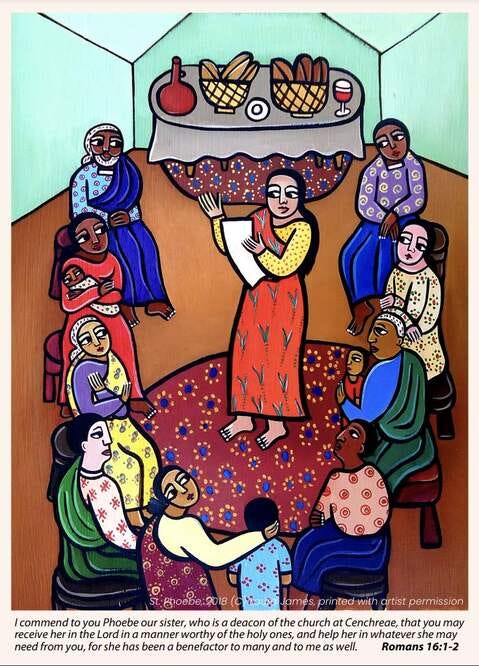
They also would have heard it. Paul’s letters were read aloud to the gathered church, and Romans was carried to Rome by a woman named Phoebe (Romans 16:1-2), and she would have read it aloud herself. A good reader could signal with her voice what our eyes now need quotation marks to see.
Meet the Gatekeeper
So who is talking in Romans 1:18-32?
The answer: a rival Christian teacher whose gospel was very different from Paul’s, and whose message Paul seems worried was reaching Rome. Near the end of the letter, Paul warns the church to watch out for people who cause divisions and deceive hearts with smooth talk (Romans 16:17-18).
In my own writing (here), I’ve come to call him “the Gatekeeper,” because his whole message is about who is in and who is out.
Watch how he enters. Paul has just announced his gospel:
Romans 1:17 “For the righteousness of God is revealed in it from faith to faith, just as it is written, ‘But the one who is righteous by faith will live.’”
Then, in the very next breath:
Romans 1:18 “For the wrath of God is revealed from heaven against all impiety and unrighteousness of people, who suppress the truth in unrighteousness...”
Two announcements. Two revelations. One reveals God’s righteousness in the gospel. The other reveals God’s wrath from heaven.
This is where the Gatekeeper grabs the microphone, borrowing Paul’s own language to preach a very different God.
His sermon goes like this: God is obvious in creation, so everyone has known better and is “without excuse” (1:19-20). People traded God for idols (1:21-23). So God handed them over to impurity, to “unnatural” relations, and to every kind of evil (1:24-31). And deep down, they know they deserve to die (1:32).
It starts with nature and ends with a death sentence.
It was also a well-worn sermon. The Wisdom of Solomon, a Jewish writing from Paul’s time (it’s included in Catholic and Orthodox Bibles), preaches nearly the same message against pagan outsiders:
God is obvious in creation: Wisdom 13:1-9 and Romans 1:19-20
Idolatry leads to sexual immorality: “the idea of making idols was the beginning of fornication” (Wisdom 14:12, NRSV) and Romans 1:23-27
A flood of vices follows: Wisdom 14:22-27 and Romans 1:29-31
The style stands out too. New Testament scholar Douglas Campbell notes how polished and self-contained the passage is, full of wordplay that doesn’t sound like Paul’s usual writing. In Greek, the four vices in verse 31 all begin with the same sound: asynetous, asynthetous, astorgous, aneleēmonas. The ESV catches the rhyme: “foolish, faithless, heartless, ruthless.”
Smooth talk, indeed.
Paul Starts Somewhere Else
Here is why this matters so much.
The Gatekeeper’s gospel rests on what scholars call natural theology: the idea that anyone can reason their way to God by studying the world around them. Look at a tree. Look at the sky. The evidence is everywhere, so nobody gets a pass.
Yet Paul consistently disavows natural theology; it’s a hallmark of his preaching.
Just listen to Paul in his other letters:
Not through wisdom: The world did not come to know God through its own wisdom (1 Corinthians 1:21).
Not from people: Paul didn’t receive his gospel from any human being. It came through a revelation of Jesus Christ (Galatians 1:11-12).
In the face of Jesus: The light of God’s glory shines in the face of Jesus Christ (2 Corinthians 4:6).
Known before knowing: Paul catches himself mid-sentence, telling the Galatians they have come to know God, “or rather,” to be known by God (Galatians 4:9).
Paul knew the other road, the natural theology road, well. He once had it all figured out: the right pedigree, training as a Pharisee, a flawless record under the law. Then he met Jesus, and he came to count everything he had worked out on his own as garbage compared with knowing Christ (Philippians 3:7-8). The Greek word there, skubala, is cruder than “garbage.” In English we would most accurately render it, “shit.” That’s what Paul thought of natural theology.
Now put that next to Romans 1:20, where the evidence of God is supposedly so clear in creation that everyone is without excuse.
Those two pictures don’t fit. Scholars have wrestled with that tension for a long time, and the solution is that they don’t fit because they come from two different people.
Here is the simplest way I know to say it. The Gatekeeper builds a ladder. Start with creation, reason your way up to God, and if you fail to climb, you are without excuse. Paul’s gospel kicks the ladder over. We don’t climb up to God. God comes down to us in Jesus, and only in his light do we see clearly, both about God and about ourselves.
The Trap Snaps Shut
Picture the house church in Rome as Phoebe reads.
The Gatekeeper’s sermon thunders toward its close. Idolaters. Sexual chaos. Gossips and slanderers. Worthy of death. Heads nod around the room. It feels good to be on the right side of God’s wrath.
Then comes the very next line:
Romans 2:1 “Therefore you are without excuse, O man, every one of you who passes judgment. For in that which you pass judgment on someone else, you condemn yourself, for you who are passing judgment are doing the same things.”
Did you hear the echo?
“Without excuse.” That was the Gatekeeper’s verdict on the idolaters back in 1:20. Now it lands on the one doing the judging. In Greek, it’s the same word (anapologētos), and these two verses are the only places it appears in the entire New Testament.
The verdict boomerangs.
If this feels familiar, it should. Remember the prophet Nathan? He told King David a story about a rich man who stole a poor man’s only lamb. David burned with anger and declared that the man deserved to die (2 Samuel 12:5). Then Nathan looked at him and said, “You are the man!” (2 Samuel 12:7).
Romans 2:1 is Paul’s “You are the man!” moment.
Remember the Wisdom of Solomon parallels? Watch what Wisdom does after two chapters of condemning pagans: it turns to its own people and relaxes. God is kind, true, and patient with us, it says, and “we will not sin, because we know that you acknowledge us as yours” (Wisdom 15:2, NRSV).
Now listen to Paul, just four verses after the Gatekeeper’s sermon ends: “do you despise the wealth of his kindness and forbearance and patience” (Romans 2:4).
Same sequence: condemn the outsiders, then turn to the insiders. Same vocabulary too: Wisdom calls God kind and patient, and Paul answers with kindness and patience, words from the same Greek roots. But where Wisdom tells the insiders they're safe, Paul confronts them.
Paul spends the rest of chapter 2 and much of chapter 3 taking the Gatekeeper’s system seriously and following it all the way to its end. If God judges everyone strictly by their deeds, with no favoritism (Romans 2:6-11), then no one is left standing. Not the pagans. Not the religious insiders. Not the Gatekeeper. By Romans 3:19, every mouth has been shut.
And then Paul’s own voice rings out again:
“But now…” (Romans 3:21)
God’s righteousness, the same righteousness Paul announced back in 1:17, now stands revealed apart from the law, through Jesus Christ. The Gatekeeper’s courtroom collapses, and Paul’s gospel picks up right where it left off.
So What About “Natural” and “Unnatural”?
This brings us back to the verses that started this whole discussion.
Romans 1:26-27 “Because of this, God gave them over to degrading passions, for their females exchanged the natural relations for those contrary to nature, and likewise also the males, abandoning the natural relations with the female, were inflamed in their desire toward one another, males with males committing the shameless deed, and receiving in themselves the penalty that was necessary for their error.”
These verses sit inside the Gatekeeper’s sermon. They are his picture of the pagan world, built on his natural theology. Paul lets the room hear that sermon clearly, then turns it back on everyone nodding along.
They are the bait, not the verdict.
Think of Job’s friends. The book of Job records their long speeches about God, suffering, and punishment, and much of it sounds deeply pious. Yet at the end of the book, God says they did not speak rightly about him (Job 42:7). Scripture faithfully records words it does not endorse. We would never build our picture of God on Eliphaz’s speeches. I don’t believe we should build one on the Gatekeeper’s sermon either.
This is where the two halves of my study finally meet.
In my original study, I noticed that the Romans 1 “formula” doesn’t match reality. Faithful people don’t start out straight, reject God, and get turned gay as a punishment. I also noticed that its idea of “natural” reflects the categories of the ancient world.
Back then, I wrote: “Do I therefore believe that Paul has put grave error into our scriptures? No.”
I still believe that. But now I understand why those problems are there. The formula falls apart under scrutiny because Paul built it to fall apart. It was never his formula. The ancient categories belong to the Gatekeeper’s worldview, and Paul quoted that worldview precisely so he could expose it.
My original reading and my new reading arrive at the same place by different roads. Romans 1:26-27 cannot be lifted out of its setting and used as Paul’s final word on same-sex relationships today.
Either Way, the Finger Turns Around
Whether you believe the natural theology sermon belongs to the Gatekeeper or to Paul, the passage lands in the same place: with the finger pointed back at the one doing the judging.
Every time Romans 1 becomes a weapon, the Gatekeeper is the one holding it.
I know this one personally. There was a time when I used verses like these to draw lines I had no business drawing. Romans 2:1 was talking to me.
If this reading is new to you, give it time. It took me years to see it.
In the next post, we’ll head to Corinth and the first of two Greek words that have caused more confusion than almost any others in this debate: malakos.
The entire series on LGBTQ+ can be followed here.