

Have you ever read Paul’s words in the New Testament and felt a sudden sense of whiplash?
For me, that feeling used to hit hardest in 1 Corinthians 11. In this passage, Paul is giving instructions about how people should look and dress when they pray. Right in the middle of his argument, he makes a sweeping, confident statement:
“Does not nature itself teach you that if a man wears long hair it is a disgrace for him, but if a woman has long hair, it is her glory?” (1 Cor 11:14-15a)
I remember sitting with that verse, utterly confused.
“How the hell does nature automatically teach us that men aren’t to have long hair?”
Does nature teach that? Have you ever looked at a man with long hair and thought that the fundamental laws of the biological universe were being violated? What exactly did Paul mean by “nature”?
For a long time, theologians have admitted that Paul’s argument here feels incredibly convoluted and difficult to follow. But what if the confusion isn’t Paul’s fault? What if the problem is simply that we are reading his words through the lens of modern science, rather than the ancient medical world he actually lived in?
To understand Paul, we have to take a trip back to the first century.
And to one of the most fascinating studies I’ve ever experienced, facilitated by scholar Troy W. Martin.
The Ancient Science of Hair
In the ancient Greco-Roman world, medical authors like Hippocrates and Aristotle held a very specific, and fascinating, view of the human body.
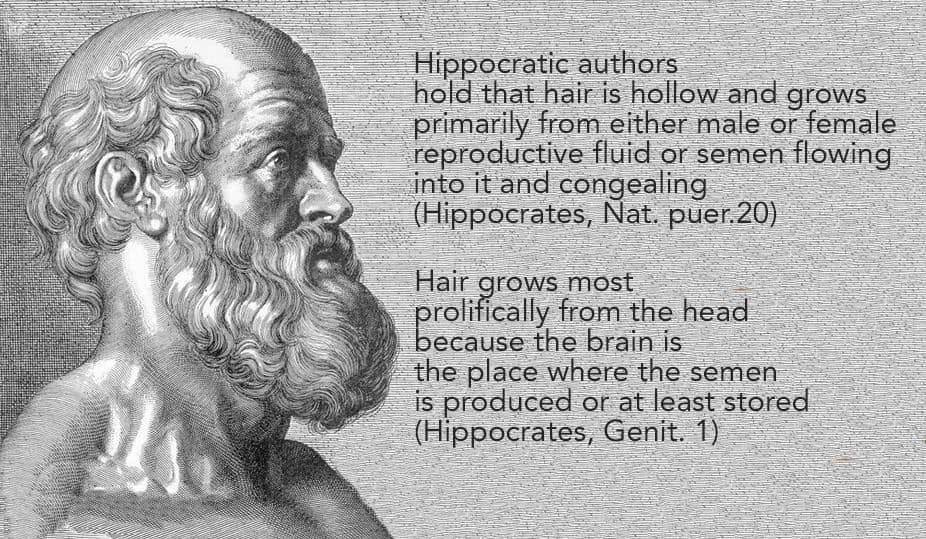
They believed that human hair was hollow.
Even more surprisingly, they believed that hair grew from reproductive fluid (semen), which they thought was produced or stored in the brain. Because it was hollow, hair acted like a vacuum. It literally attracted and drew this fluid upward.
According to these ancient medical texts, the biological “nature” (or physis) of a man was to eject this fluid. Therefore, a man with long, hollow hair would retain his semen, drawing it upward toward his head and away from where it should be ejected.
This is exactly why Paul states it is a shame for a man to have long hair. In the scientific understanding of his day, long hair went against the male “nature” to eject semen.
The Female “Nature”
But a woman’s “nature” was understood to be the exact opposite.
Ancient doctors believed a woman’s body was designed to draw up and retain the seed to form a child. Her long, hollow hair assisted her uterus by increasing her body’s suction power, helping to draw the fluid upward and inward.
This brings us to one of the most misunderstood and shocking translation issues in Paul’s letters.
In 1 Corinthians 11:15, Paul says a woman’s hair is given to her “instead of a covering.” The Greek word used here is peribolaion. Modern translators almost always render this as a general garment or a veil.
But in ancient Greek medical and physiological contexts, peribolaion was used to refer to a testicle.
Read that again.
Troy W. Martin’s crucial article shows that Paul is actually arguing that a woman is given long hair instead of a testicle. (Journal of Biblical Literature, Spring, 2004, Vol. 123, No. 1 (Spring, 2004), pp. 75-84)
For men, testicles were viewed as weights that kept the seminal channels taut, facilitating the drawing of semen downward. Women do not develop these weights. Instead, their long hair does the functional work of drawing the fluid upward.
Therefore, long hair is a glory for the female “nature” but a shame for the male “nature,” just as Paul states.
The Veil and the Sanctuary
When you understand this ancient science, Paul’s instruction for women to wear veils in church suddenly makes complete, logical sense.
Because ancient science viewed a woman’s hair as an active part of her reproductive system—essentially an external part of her genitalia—Paul asks the Corinthians if it is proper for a woman to display her genitalia when praying to God.
Jewish tradition strictly forbade the display of genitalia when engaged in God’s service. Priests serving at the altar were even required to wear special linen breeches to cover their flesh so they would not be exposed and incur guilt.
Informed by this deep tradition of reverence, Paul was simply instructing women to be decently covered in public worship according to the best medical science of his day.
Dropping the Gavel
So, where does this leave us?
We no longer believe that hair is hollow. We know it does not act as a vacuum for reproductive fluid. Since our physiological understanding of the human body has changed, the physiological reason for women to wear veils in church is gone.
But there is a much larger, more pastoral lesson here for us.
When Paul appeals to “nature” in his letters, he is not dropping a timeless, universal moral law from heaven. He is speaking from the culturally conditioned, ancient science of the first century. He is using the medical parlance of his day to encourage decency and order.
Sit with that reality for a moment.
If Paul’s arguments about what is “natural” for gender and bodies are deeply rooted in ancient, outdated biology, how much damage do we do when we weaponize those ancient categories against people today?
What happens when we use a first-century medical textbook to judge a twenty-first-century life?
Perhaps it is time we recognize that “nature” in Paul’s writing is a lot more complicated than we were taught. And perhaps, recognizing that complexity is exactly what gives us the freedom to put down our stones, drop our gavels, and step fully into the grace of Christ.
Nerd Alert
If you are super nerdy like me and would enjoy a bit more information and to read the material directly, here is a great video breakdown I created and a copy of Troy’s original article that can be found for free in many places across the internet.

I’ve always wanted to know why Paul gave those directions.!
I wonder how many verses in Romans alone contain instructions or admonitions based on science of the times that has no connection to science as we know it now.
In a few hundred years, will the science that we are familiar with be considered mythical?
Will they look at our writing and believe it conveys something completely different from what we understand now?
Feeling like a two year old who asks why after every explanation.
I would like to know how this maybe ties into guys like Samson. Also, I know a lot of Occult and Esoteric traditions talk about drawing the "seminal vapors" up the spinal column to the brain to help men fully embrace their potential. Very interesting!