

In my last post, we finished the five passages most often brought into this conversation, and we came out the other side without a clear condemnation of homosexuality.
But there’s another significant matter we have to consider.
Homosexuality isn’t referred to directly in Leviticus 18 and 20 or in Romans 1, and it isn’t clear in Paul’s words malakos or arsenokoitēs. But could it be included under another Greek word, porneia? Our Bibles usually translate it with something more general, like “sexual immorality” or “fornication.”
Some form of porneia shows up in both of Paul’s vice lists we just looked at, in 1 Corinthians and 1 Timothy. It’s also one of the four things the council in Jerusalem tells gentile believers to abstain from (Acts 15:20, 29).
No study on homosexuality would be complete without asking what this word means, and whether it applies.
Where the Word Comes From
Historian Kyle Harper has written an excellent review of this word and how its use evolved in Jewish and Christian writing. What follows draws largely on his history of the word, though he and I part ways on what it means for same-sex relationships.
Harper notes that porneia wasn’t a common word among the Greeks and Romans. It “occurs in only four classical authors.” But in Jewish and Christian literature, it shows up nearly four hundred times before AD 200, and over eighteen hundred times between 200 and 600.
So it was Jews and Christians who took up this word, made it popular, and, in the process, shaped what it meant.
Adultery Was Wrong, Prostitution Was the Cure
To understand why Jews and Christians first reached for porneia, we have to understand the ancient, patriarchal culture.
Prostitution was a common practice in Greek and Roman life. Adultery (sleeping with a married woman) was frowned upon, because it was seen as the violation of a respectable woman. And the shame of adultery didn’t fall mainly on the woman, who was seen as passive in the act. It fell on her husband, whose property, his household, had been disgraced through his wife by her lover.
A prostitute, however, was not a woman of respect, and she belonged to no man. That made her freely available, without the condemnation that came with seducing another man’s wife.
This led the Greeks to consider prostitutes an excellent safeguard against adultery. In fact, prostitution was viewed as necessary to society, to safeguard the respectable women and stave off the domestic violence that could result from adultery.
The Romans carried this perception forward. The Christian writer Salvian noted that the Romans forbade adultery while building brothels.
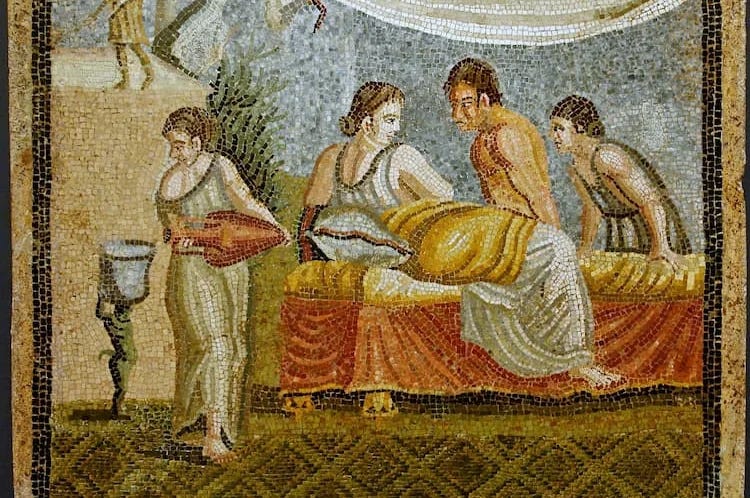
The Jewish philosopher Philo describes the world around him this way:
“Among other peoples, it is permitted for young men after their fourteenth year to use without shame whores, brothel-girls, and other women who make a profit with their body.” (Philo, On Joseph)
So in the secular society of the New Testament, adultery was wrong, and prostitution was the cure.
A New Standard
The Gospels change this. They record Jesus’ lists of vices, and those lists include both adultery and porneia (Matthew 15:19; Mark 7:21-22). Jews and Christians would have understood Jesus to be condemning the otherwise culturally accepted use of prostitutes.
That makes sense of why the Jerusalem council had to make a point of it for the gentiles. Their Greco-Roman culture had taught gentiles that using prostitutes was morally acceptable.
It also tells us why Paul names porneia in his letters. He writes to Corinth, a thoroughly Roman city where prostitution would have been commonplace. And he writes to Timothy in Ephesus, one of the most important Greek cities, where believers would have been just as steeped in the belief that using prostitutes was morally acceptable.
Marriage Is the Answer
For Jews and Christians, though, porneia held a broader meaning than the use of a prostitute. It covered all sex outside of marriage.
Paul shows this in 1 Corinthians 7, where he names marriage as the godly solution to porneia (1 Corinthians 7:2). By placing porneia opposite marriage, he expands it to cover a whole list of sexual sins: prostitution, incest, pederasty, and even the culturally accepted sexual abuse of slaves.
In other words, the world offered porneia (prostitution) as the fix for adultery. Paul declared marriage to be the holy resolution for porneia (any sex outside of marriage).
In Paul’s culture, easy, socially acceptable sex was readily available to men. So that a man wouldn’t fall into the temptation of accessing this sex outside of marriage, Paul believed the unmarried man should marry, so he could then have sex morally.
Philo’s thinking runs parallel to Paul’s. He considered all legitimate sex to belong exclusively to marriage.
Note: Even though Philo confined sex to marriage, he and others believed passion itself had no place in the marriage bed. Sex was a solemn matter, to be tempered. We’ll see this idea come up again with Augustine.
Clement of Alexandria echoes Philo and Paul’s line between porneia and sex within marriage: “Fornication and marriage are therefore different things, as far apart as God is from the devil.”
And the Apostolic Constitutions, an early church work, warned that the young could easily “fall into fornication.” So parents should “endeavour, at the time when they are of an age fit for marriage, to join them in wedlock, and settle them together.”
Where Does This Leave Us?
Looking at how Scripture uses porneia, along with how Jewish and Christian writers used it more broadly, the word points to a wide range of sexual activity outside of marriage, much of which was condoned by the secular culture of the day.
But this series is considering a loving, monogamous same-sex couple, and their sex within marriage.
Porneia can’t be understood to apply.
With the Bible’s explicit passages and terms now behind us, there are a few other arguments about homosexuality left to consider. These are more philosophical in nature. Some are still tied to Scripture, while others are not.
Next time, we’ll start with one many of you’ve probably heard: “God made Adam and Eve, not Adam and Steve.”