

In my last post, we looked at the first of two Greek words in 1 Corinthians 6:9: malakos, “the soft ones.” Now we turn to the second.
1 Corinthians 6:9 “Or do you not know that the unrighteous will not inherit the kingdom of God? Do not be deceived! Neither sexually immoral people, nor idolaters, nor adulterers, nor passive homosexual partners (malakos), nor dominant homosexual partners (arsenokoitēs)…”
1 Timothy 1:10 “…sexually immoral people, homosexuals (arsenokoitēs), kidnappers, liars, perjurers, and whatever else is opposed to sound teaching…”
Paul uses arsenokoitēs only twice, in these two verses. In 1 Corinthians, it comes right after malakos. In 1 Timothy, it stands alone.
Now look at the translation. It’s the same Greek word in both verses, but in one it becomes “dominant homosexual partners” and in the other, the generic “homosexuals.” The translators made a choice there, too, and you can see the assumption behind it. When the word sits next to malakos, they treat the two as a pair: the passive partner and the dominant one.
That assumption is where we’ll start.
A Word Built From Leviticus?
Arsenokoitēs is a strange word. As far as we know, Paul’s letters are the first place it shows up anywhere in Greek literature.
It’s a compound of two words: arsēn (male) and koitē (bed, often with a sexual sense). Many scholars think Paul, or Jewish writers before him, built it from the Greek translation of Leviticus that his churches read. In Leviticus 20:13, those two words sit side by side: a man who lies with a male (arsenos) in the bed (koitēn) of a woman.
On this reading, arsenokoitēs is Leviticus compressed into a single word: a “male-bedder,” a man who takes another male to bed. Traditionalist scholar Robert Gagnon makes a case for this in his major work, The Bible and Homosexual Practice.
But part of his case leans on reading malakos as the passive partner and arsenokoitēs as the active one, two halves of one same-sex act. The pairing does a lot of the work.
And if the word really does come from Leviticus, it brings Leviticus’s limits along with it. We’ll come back to that.
The Missing Partner in 1 Timothy
If malakos and arsenokoitēs are a matched pair, the passive and active halves of one act, then 1 Timothy raises a question. Paul uses arsenokoitēs there without malakos.
Where did the other half go?
Many traditionalists have an answer: arsenokoitēs on its own covers both partners, so Paul didn’t need the second word.
But notice what they concede: the two words don’t have to travel together. Paul can use arsenokoitēs without malakos. And once the pair is broken, each word has to stand on its own.
We’ve already seen where malakos actually lands, as Jesus’ own use of the word shows. It’s a word about going soft in luxury, the word Jesus used for the pampered people in royal palaces, and it shows up only in Paul’s letter to opulent Corinth, not in his letter to Timothy in Ephesus. If that’s right, malakos was never the passive partner in the first place, and the “pair” is one that translators supplied.
So the real question is what arsenokoitēs means by itself.
The Women Are Missing Again
Here’s the first problem with reading arsenokoitēs as “homosexual.” It only covers men.
If the word comes from Leviticus, that shouldn’t surprise us. We spent two posts on those verses, and they never mention women with women. Leviticus addresses men lying with males, and women with animals, but never women with women. Arsenokoitēs does nothing to widen that. It names a “male-bedder,” and that’s all.
That’s a strange way to name homosexuality as a whole. Half of it is missing.
And it isn’t that Paul never thinks about women’s sexuality. In the very next chapter of 1 Corinthians, he goes out of his way to address husbands and wives in parallel, line by line (1 Corinthians 7:2-4). When Paul wants to speak to women, he does.
Here, he doesn’t. Whatever arsenokoitēs names, it isn’t “homosexuality” as we use the word today.
Where Else the Word Shows Up
Since Paul doesn’t define arsenokoitēs, the best way to learn what it meant is to watch how other early writers used it once Paul introduced it. New Testament scholar Dale Martin did exactly that, and he noticed a pattern.
Ancient vice lists tend to group sins by type: sexual sins together, violent sins together, and so on. When arsenokoitēs shows up in these lists, it often isn’t sitting with adultery and other sexual sins, where you’d expect a word for gay sex to be. It’s sitting with sins of economic injustice and exploitation.
Here is some of the evidence:
The Sibylline Oracles: In a section on justice, the command not to arsenokoitein sits alongside commands about wealth, robbery, and fraud, followed by commands to pay workers their wages and not to oppress the poor. The oracle deals with sexual sins elsewhere, and the word isn’t among them.
The Acts of John: An early Christian writing denounces the rich who prosper by exploiting others: “the poisoner, sorcerer, robber, swindler, and arsenokoitēs, the thief.” Sexual sins appear in a different section, and again the word isn’t there.
Theophilus of Antioch: A second-century bishop borrows Paul’s vice list. He puts adultery and fornication first, then thief, plunderer, and defrauder, and only then arsenokoitēs. Three economic sins separate it from the sexual ones. In another list, it sits at the transition point between the sexual sins and the sin of greed.
Hippolytus: In one of the few places where the word clearly involves sex between males, the act is described as taking a man the way one would use a slave boy. The sin isn’t pictured as love between equals. It’s sex as domination. Power rape.
In a a couple of ancient cases where the word is found as a predatory sexual sin, it found as Zeus seizes and rapes a teenage boy and a serpent god, Naas, who overpowers and rapes the Adam of Genesis, “like a boy.”
Put those together, and arsenokoitēs is revealed as sex bound up with money and power: using your position to take sex from someone who can’t refuse, particularly and adult man acting against a young boy.
We have modern categories for this type of economic and power sexual violence. A landlord who demands sex from a tenant who can’t make rent. A pimp who sells someone else’s body for profit. A boss or teacher who uses their power and influence to exploit an employee or student sexually. We don’t call any of those “homosexuality.” We call them exploitative rape.
Reading Paul’s Lists Again
Now look back at Paul’s own lists with that in mind.
In 1 Corinthians 6, the list opens with sexual and religious sins: the sexually immoral, idolaters, adulterers. Then come malakos and arsenokoitēs. Then thieves, the greedy, drunkards, the abusive, and swindlers (1 Corinthians 6:9-10).
Read the way I’ve come to read these two words, the list turns a corner right where they appear. The two words become a bridge from sins of sex to sins of money.
Here is how I see the list in 1 Corinthians progress:
Sexual and religious sins
Sexual immorality (in general)
Idolatry (which often involved sex acts in the ancient world)
Adultery (a more specific sexual immorality)
Pivot to positional and economic immorality
Moral softness (in general): malakos
Sins against others (economic and privilege sins)
Sexual exploitation by power and/or for economic gain: arsenokoitēs
Theft
Greed
Drunkenness
Verbal abuse
Swindling
1 Timothy works the same way. The word comes right after “sexually immoral people” and right before “kidnappers,” a word for slave dealers who trafficked in human beings (1 Timothy 1:10).
Here is how I see the second half of the list in 1 Timothy progress:
Relational and sexual sins
Killing family
Murdering others
Sexual immorality
Pivot from sexual sin to economic sin
Sexual exploitation by power and/or for economic gain: arsenokoitēs
Economic sin
Human trafficking (stealing people and their freedom)
Lying (stealing the truth)
Perjury (stealing justice through false oaths in courts and contracts)
In both lists, arsenokoitēs sits at the seam between sexual sin and theft. That’s similar to where Theophilus put it in one of his lists, as a transition between the sexual sins and greed.
Some scholars, like Robin Scroggs and James Brownson, connect arsenokoitēs and "kidnappers" in 1 Timothy to the ancient sex trade, where slave dealers supplied boys to the men who used them.
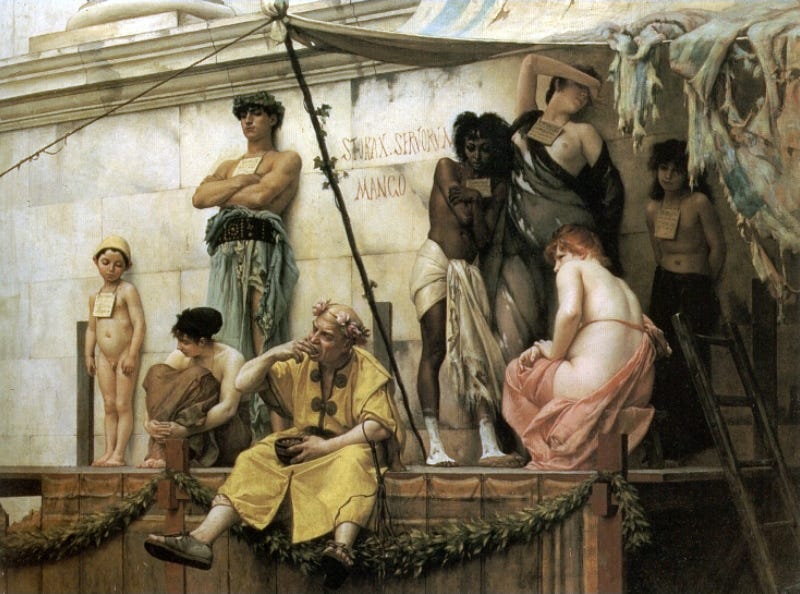
That placement makes the most sense to me if arsenokoitēs involves both sex and exploitation. Not two people in a committed relationship, but someone using their power to take another person’s body. The term Paul introduced bridges crimes that mix sex and economics.
Where Does This Leave Us?
Let’s put it together.
Arsenokoitēs is a rare word that Paul likely coined. If he took it from Leviticus, it inherits the world of Leviticus too: a world that, as we saw, was concerned with who penetrated whom in a patriarchal order, not with committed same-sex relationships.
The word also names only men, so whatever it means, it can’t be a word for homosexuality as a whole.
And the company it keeps is telling. In early writings outside the Bible, it shows up again and again beside theft and fraud. In 1 Corinthians, it sits right where sins of sex give way to sins of money. In 1 Timothy, it sits right next to the slave trade, another economic sin.
Here's how I put the pieces together. Paul borrowed his vocabulary from Leviticus, but words mean what their users mean, not what their parts add up to. A butterfly isn't a fly made of butter. In use, arsenokoitēs named a man's misuse of the "bed" in the broadest sense: sexual exploitation. And in the lists we have, that exploitation runs through money and position. Again, power rape.
And if that’s right, this word asks something hard of the church, too. We don’t have to look far for leaders who used their position to take what wasn’t theirs: pastors with congregants, priests with children, ministries that protected the powerful instead of the vulnerable. If we want to take arsenokoitēs seriously, that’s where it points.
That’s a sobering place to land. It should be.
With all five passages now behind us, we still haven’t found a clear condemnation of homosexuality. Next time, we’ll turn to a broader word Paul uses for sexual sin: porneia.