

Analyzing the Passages: Where to Start (and Where Not To)
When approaching the biblical texts that address same-sex behavior, the discussion usually centers on five primary passages. Many of you are likely familiar with the list:
Leviticus 18:22
Leviticus 20:13
Romans 1:26-27
1 Corinthians 6:9
1 Timothy 1:10
For many in modern evangelicalism, these verses have been understood to form a unified, definitive stance. But as I leaned in closer, willing to ask the hard questions, the wall began to look more like a mirror reflecting ancient language, complex cultural concerns, and a world vastly different from our own.
As my study progressed, I realized that unfortunately, for such an important topic in our era, the Bible really doesn’t have a lot to say on the issue of homosexuality—especially not in the form of loving, covenanted relationships as I was studying it.
But Wait... What About Sodom?
The glaring omission that many may point to here, is that we are missing the story of Sodom.
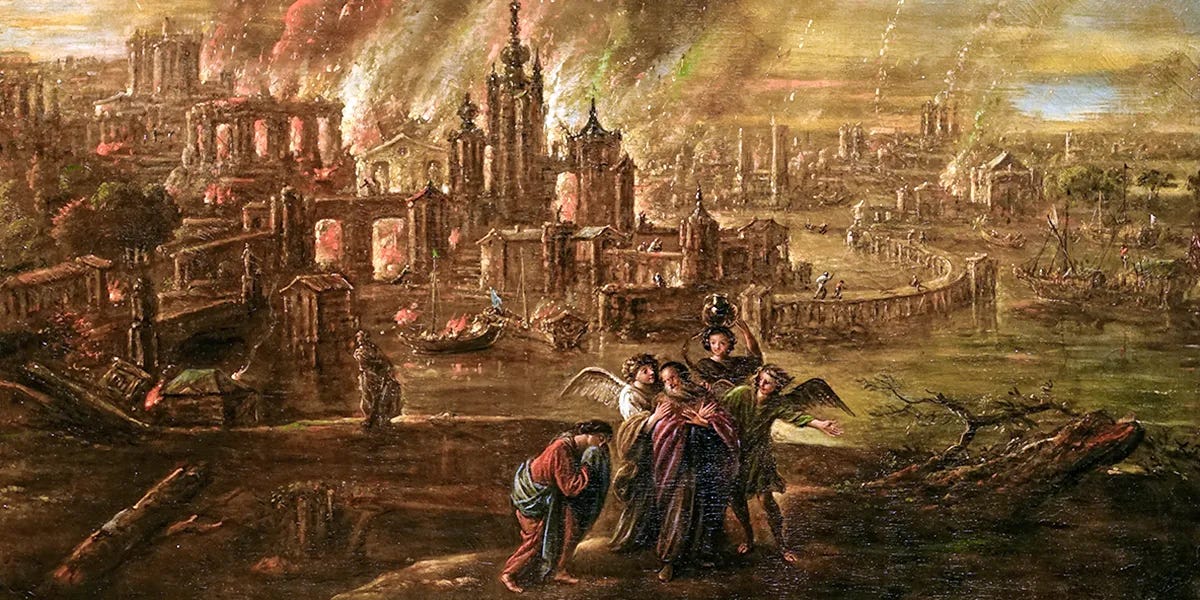
“But wait!” they say. “What about the story of Sodom? Didn’t God destroy a whole city because of homosexuality?”
It’s a fair question. It’s the story we’ve been told.
But what if we need to look again? What if our assumptions about Sodom are masking a much deeper, more tragic reality?
When we place the story of Sodom (Genesis 19) alongside its sister story of Gibeah (Judges 19), a very different picture emerges.
These are not stories about romance or innate same-sex attraction.
They are stories about brutality.
In the ancient Middle East, hospitality wasn’t just polite; it was paramount. Protection of guests was a sacred duty. Yet in both Sodom and Gibeah, the locals offer no welcome to the visitors at their gates. Instead, the only hospitality comes from foreigners living in the city: Lot in Sodom, and an old man in Gibeah.
Then, the mob arrives.
They demand the male guests be brought out so they can be raped.
It is horrific. And it has nothing to do with sexual orientation. In various ancient cultures—and tragically, even today in such places as prisons and conflict zones like South Africa and the Congo—the rape of a man by another man serves as a violent display of power. It was a tool of degradation. An emasculation of an enemy.
These men had no same-sex desire. They weren’t looking for lovers. They were looking to dominate.
The Tragic Reality of Patriarchy
How do we know this? Because of what happens next.
To appease the violent mob, the hosts offer something else. Women.
The hosts understand what is happening is not homosexual in nature.
Lot offers his own daughters. In Gibeah, the concubine is offered—and tragically accepted.
If this mob was driven by innate same-sex attraction, would they have accepted women? What does it say about the devastating reality of this patriarchal society that a daughter or a female guest was viewed as a bargaining chip to protect a man’s honor? What happens when a culture values a man’s pride more than a woman’s body?
Do you see how the stakes change when we look closer? The stories are heartbreaking, but they are not about homosexuality. They are about cruel, inhospitable people who cared more for displaying dominance than for human life.
How Jesus Read the Story
If we are going to test the validity of this understanding of Sodom, perhaps we should look to Jesus.
When Jesus sent out his disciples, he provided his own commentary on the sin of Sodom:
“And whoever does not welcome you or listen to your words, shake off the dust from your feet as you are going out of that house or that town. Truly I say to you, it will be more bearable for the region of Sodom and Gomorrah on the day of judgment than for that town!” (Matthew 10:14-15)
Did you catch that?
Jesus contextualizes their sin strictly in terms of being inhospitable.
If Sodom was judged so severely for violently rejecting “random” strangers, Jesus warns, how much harsher will the judgment be for those who reject the way of Christ and his messengers?
Ultimately, the consensus that Sodom is not a text about consensual same-sex relationships crosses theological lines. Even when he held to a traditional view, the respected scholar Richard Hays rejected the idea that the story of Sodom has a place in this discussion.
So, we set Sodom aside.
A Moment to Sit With It
But I know this isn’t just an academic exercise.
If you grew up hearing Sodom preached as a terrifying warning against the LGBTQ+ community, pausing to read it as a story about hospitality and violence might feel unsettling.
Sit with that for a moment.
What changes inside us when we allow the text to speak to its actual historical context?
What if the real sin of Sodom—the hostile rejection of the vulnerable "other"—is closer to our own modern lack of hospitality than we ever dared to admit?
We’re going to take this slow. In the next post, we’ll turn our focus to the actual texts in question, beginning with the Leviticus passages.