

This is the second post in the Fresh Look series. The first post can be found here:

(I don’t claim that what follow is the only way one would read Genesis if they came to the Bible without being told the “right” way to read it, but I offer the following as a way the Bible may begin to come across in a completely unadulterated reading.)
I imagine that if you began to read your Bible without being told how to read it, you would start at the beginning.
And as you start at Genesis without any background—no sermons, no categories, no assumptions—you wouldn’t come to it with one of the top questions most people bring:
“Is this literal or symbolic?”
You wouldn’t even know there was a debate. You’d be reading a book you picked up off a shelf with no idea what kind of book it is. Is this history? Is it myth? Is it moral storytelling like Aesop’s Fables?
You wouldn’t have a lens yet.
And without that lens, you wouldn’t even know whether the author is getting any of the details “right”—or whether that question even makes sense for this kind of writing.
So you’d just… read.
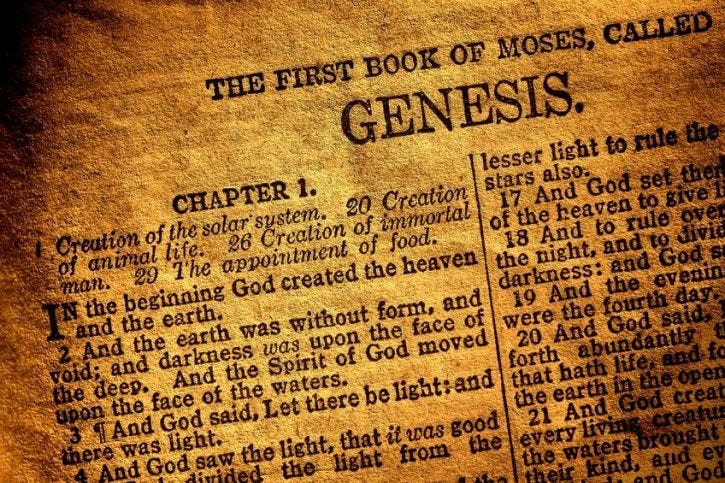
A Community at the Beginning of Everything
Right away, you would notice something curious in the opening pages: the language is strangely communal.
God speaks like a “we.”
Humanity is made as a “they.”
Yet somehow, the “they” of humanity reflects the “they” of God in a single image.
26 And God said, “Let us make humankind in our image and according to our likeness, and let them rule over the fish of the sea, and over the birds of heaven, and over the cattle, and over all the earth, and over every moving thing that moves upon the earth.” 27 So God created humankind in his image, in the likeness of God he created it, male and female he created them. - Genesis 1
Even if you couldn’t explain it precisely, you’d feel the impulse in the text:
Community and communal identity is there from the very start.
And you’d see it again when marriage is described—a man leaves one community to form a new community with a woman.
Humans are shown as individuals, yes, but they seem to only be themselves within relationship with other humans.
Genesis opens with:
A God of community
A humanity of community
God and humanity in community
The First Fracture
Then something happens.
Eve is enticed toward an action that is entirely self-referential—something done for personal satisfaction. It’s the first moment in the story where the “I” pulls away from the “we.”
And the community fractures.
Not because God withdraws, but because Adam and Eve do.
If you knew nothing about theology, you wouldn’t call this “original sin.”
You’d simply see a story about the breakdown of relationship—the loss of togetherness, the beginning of alienation.
And you would have to wonder about how God handles things.
Are God’s actions in Genesis 3 simply a punitive tit-for-tat to rebalance some justice system we don’t know about?
Or is he taking actions which will ultimately lead to the reunification of community?
A Book About Broken Family
You turn to Genesis 4, and things escalate quickly.
Cain murders Abel, and the line that echoes from that moment is:
“Am I my brother’s guardian?”
If you’d never read Scripture before, you might decide, as you continue reading Genesis, that Cain’s question turns into the thesis of the whole book.
“Can’t I just care about me? Do I have to care for others?”
Genesis seems to be asking it over and over:
What happens when siblings don’t care for each other?
What happens when they do?
What happens when relatives deceive each other?
What happens when they reconcile?
What happens when humans choose self over community?
What happens when they choose each other instead?
From Cain and Abel to Jacob and Esau, Joseph and his brothers, families rise and collapse on the same fault line—
the fragile tension between care and indifference.
Genesis reads like an extended exploration of one truth:
Community is costly.
Fractured community is even costlier.
But Who Is This God?
Reading Genesis without inherited explanations leaves you with some open questions—unsettling ones.
Who is this God who seems able to wipe humanity from the earth—including infants—yet who also works mercy into every fracture?
Who judges people so fiercely, yet brings good out of the evil that people do?
So early in this pure reading, you probably shouldn’t try to resolve all those questions too quickly. For now, perhaps you simply note that the portrait of this God is complex, unfinished, and even contradictory.
You’d keep reading.
What Genesis Leaves You With
But even without answers to everything, one theme seems unmistakable if you’re reading Genesis as a first-time reader:
This is a story about the breakdown of community and the longing for its restoration.
It is a story that claims all humans are a great community of family, descending from a single set of parents.
This is a story about humans who forget how to care for one another, and a God who keeps calling them back.
A story in which the central moral is not hidden:
Things go terribly when we refuse to be our fellow humans’ protector.
Things go far better when we choose to care.
Perhaps this is Genesis before modern doctrines, before our debate, before the arguing schools of interpretation get their hands on it.
Read with fresh eyes, it looks less like the author intended a book about the origin of the universe and more like a book about the problem of human estrangement.
And the author seems to be creating a hope in the reader that broken community might someday be healed.